

Bruckner Symphony no. 4 in E flat, 'Romantic'
a great first stop for newbies to Bruckner, being sort of his breakout symphony
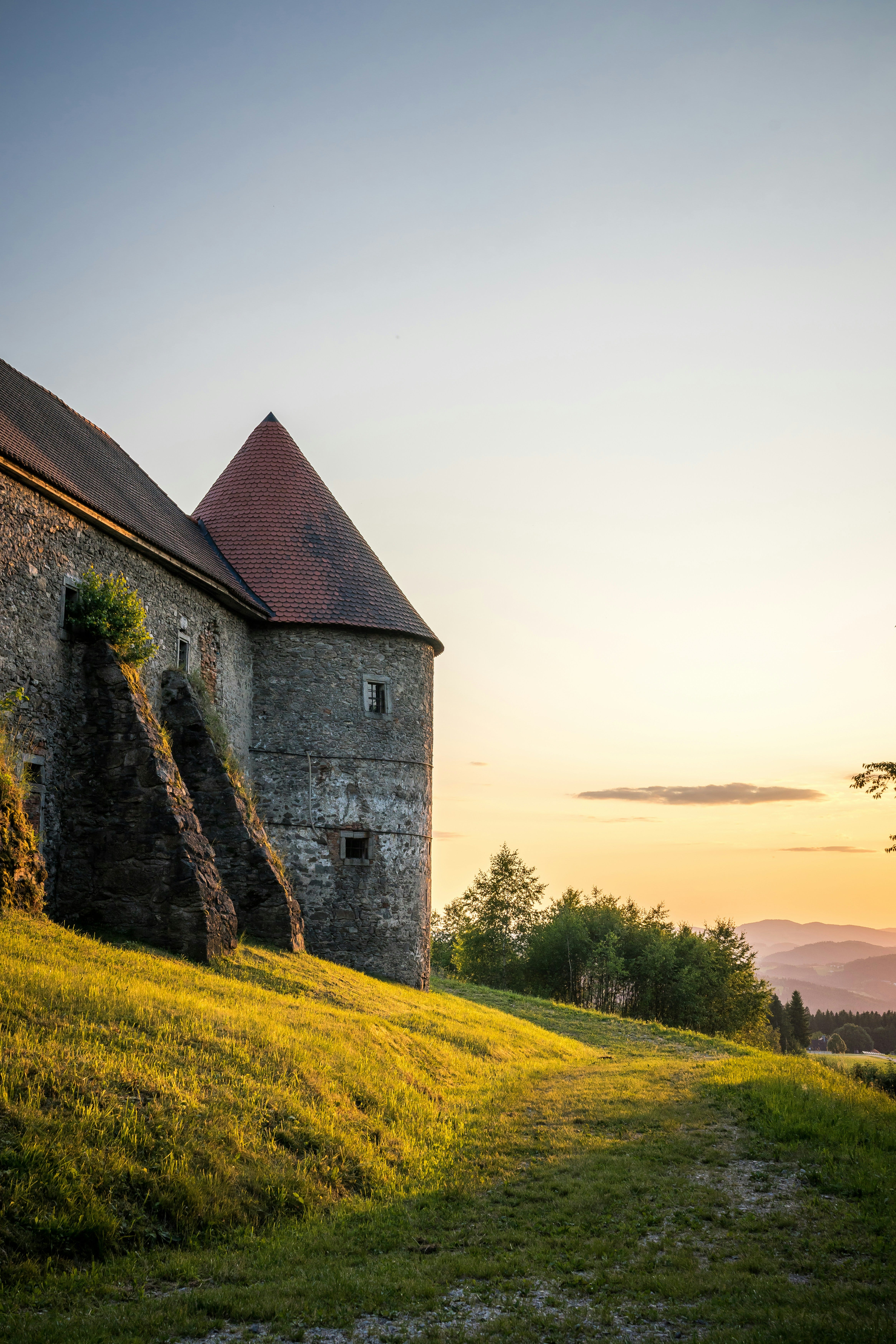
performed by the Rundfunk-Sinfonieorchester Saarbrücken under Stanisław Skrowaczewski
You might think that I of course planned to feature this symphony in the program just after the one where I featured Rautavaara’s magnificent Bruckner-inspired (?) symphony, and I’d love to take credit for planning it that way, but it’s entirely coincidental.
Fantastically, though, if you are only familiar with the one and not the other (or neither), here’s your chance to go listen and compare. Bruckner’s is something like twice as long, but it is a grand, epic, enormous, beautiful journey very worth taking, and we’ll talk about that here.
This is a piece that I heard about and began listening to in my early days of classical music, and I used that brute-force technique that was typical of much of my listening at the time. Listen enough so that you know the contours and shape and play-by-play of the piece, but I was woefully, searingly, dizzyingly ignorant of what later made me really unbelievably impressed by the piece.
Listening as Reading
Think of it this way: most children’s stories are told and solely focused on the immediate action of what’s happening at the time: someone is lost in the woods, or kids need to survive, or the pigs are trying to be safe from the wolf, whatever. Even if a lit teacher could weave up an analysis or discussion of themes and motivations of the characters, the target audience really doesn’t think that way, so it’s very much about what happens from moment to moment: is this conversation or scene exciting/scary/interesting?
What’s lacking in this approach?
Any understanding of the interconnection between otherwise disparate events. They would just be one thing that happens after another thing, with no consideration for why or how. Once you incorporate the potential thoughts, feelings, motivations, goals, fears of (a) character (s), you begin to think of content in themes, in broader, connected groups of ideas: “How does this event advance or hinder the plot?” or a specific character’s goals? Now suddenly everything has a purpose and some interrelation or other to everything else, and that’s when we start to derive deeper meaning from a story because there’s purpose and intent and feeling attached.
This is going to be a long article, if you didn’t guess by now.
Large-scale Themes
The other thing that’s very relevant here is the question of the size of the ‘story arc,’ so to speak. In a TV show, you have storylines that belong to the individual episode, a problem or event whose entire trajectory begins and ends within the one-hour segment. It doesn’t have much impact on the larger-scale direction of the season or series. There are larger-scale arcs that may take a few episodes to resolve and leave cliffhangers between episodes.
Lastly, there are arcs that belong to the entire season, or even across seasons, those which are only developed slowly and not resolved until the end of the season. This gives unity to the large-scale story and promotes a sort of loyalty to viewers that keeps them coming back.
Now Music
So how does this relate to classical music?
It’s obvious that a movement of a symphony has some of its own material. But there are symphonies, like this one, Schumann’s second, Saint-Saens’ third, Vaughan Williams’ second, or others, that have content that belongs to the overall symphony rather than just a movement. These larger arcs serve to connect opening and closing movements, to give a sense of grandness and purpose to these larger, longer symphonies.
It may take the form (as in the Vaughan Williams) of a cyclical nature, quoting in the epilogue of the finale something that appeared in the introduction of the first movement. In other cases, a theme or variation on it is woven throughout the very fabric of the work, serving as the backbone of the entire thing.
And it’s that kind of spirit we have here in this enormous symphony.
The Importance of Structure
This article is long enough without a thesis on music theory, but think of structure like a bridge: the shorter a span a bridge has to cover, the simpler the structure can be. The longer a span, hundreds of meters or even many kilometers, the more complex and sturdy the bridge needs to be. More importantly, it must support not just the weight of the passengers across it, but also its own weight.
That’s kind of what we’re working with here. The grander and ‘heavier’ a symphony gets, the more demand there is on the content to support the ‘weight’ of the structure, the more important it is for the conductor to lay out an interpretation of the piece (pacing, for example) informed by the content, what’s important, what should standout or be emphasized, etc.
This is yet another thing that makes Bruckner’s works sort of easy to get lost in. Mahler almost always gives you something to focus on. He can be very loud about “this is what’s going on right now and what’s important. Listen to me,” but there’s a breadth and grandness that can be overwhelming in his music, like trying to photograph an entire mountain range. You can’t zoom out enough to get the whole thing, so how do you frame it such that it’s a complete, standalone thought?
That illustration makes sense in my head.
Now that we’re done talking about the enormous hugeness of Bruckner and his structure overall, let’s have a look at the actual music, and in the coda (of this article), I’ll get back to how I used to hear this piece and how I hear it now after giving it a more analytical study.
Music
I lied. Two things can’t go without at least mentioning, and if you find them interesting, you can go do your own research:
‘The Bruckner Problem’- The man was an incessant reviser and rewriter of his work, so there are myriad versions of this work from the composer himself, and then people like Haas and Novak come around and make their final performance editions that are compiled from or based on versions the composer made in a certain year. This means that depending on which recording you listen to, you may need a different score to follow along, or vice versa. As wonderful and marvelous as Simone Young’s Bruckner recordings are with the Hamburg Philharmonic (when that was their name), she uses the earliest versions of the symphonies, which she vouches for, and it’s great to have such amazing performances on record but I’d have loved a more ‘standard’ version from her.
The withdrawn program notes- Although he later withdrew these notes (like Mahler and Vaughan Williams would with symphonies of their own), there was a time when a program existed for this symphony. Perhaps it was only the springboard in the composer’s mind for what he was aiming to achieve with the symphony rather than actual program music, but in either case, he later retracted them. We do have mentions like the below that Bruckner wrote in letters to friends or elsewhere:
In the first movement after a full night's sleep the day is announced by the horn, 2nd movement song, 3rd movement hunting trio, musical entertainment of the hunters in the wood.
I may reference this stuff below (most likely just the program notes), so there it is. Now to the music.
The first movement begins with such characteristic Bruckner things: tremolo strings and a horn solo, and then ‘the Bruckner rhythm',’ as below:

Not only does it appear in a number of his symphonies, especially this one and the sixth, it’s a critical part of this work, one of the motifs that belongs to the symphony overall rather than just this movement.
The horn theme is sort of theme 1A, and that Bruckner rhythm is 1B. These two parts make up what’s often referred to as a ‘theme group’ because it’s a group of subjects or motifs rather than just a standalone single subject like we might have from Mozart or Beethoven. This first theme group, marked in the score video below in blue, is kind of the heart and soul of the whole symphony.
This portion of the sonata-form first movement isn’t just ‘loud,’ it has mass. It’s big and heavy and is certainly at times loud, but also just big, even in recordings. The writing for brass is almighty and jaw-dropping.
In contrast with that, we have the second theme group, marked in green. It’s dainty, small-scale, personal, intimate. How else could you contrast what came before it? It’s charming and at turns very Viennese sounding, but still pastoral and rural, for lack of a better word.
We are in sonata form, but we’re not done with theme groups yet. There’s a sort of third theme group that’s based on the Bruckner rhythm from TG1, but now that Bruckner rhythm is descending (mostly) rather than ascending. We get a closing section and then jump into the development. No more play-by-play because this is going to be a long piece, but if you recognize those building blocks from the exposition, you’ll start to see how they’re handled in the development and recapitulation. Breathtaking first movement.
The second movement is our slow movement, and it’s funereal, profound, moving, and grand. In his later withdrawn program notes, I was certain there was something about a funeral march for a beloved hero, although the topical similarity to Mahler’s first made me suspicious that I was wrong. According to some sources on the interwebs, Bruckner expressed that this movement depicts a romance in which a peasant boy pursues his sweetheart, only to be rejected.
However, in my mind, it’s still a funeral march. Whatever you think or decide it is, it’s largely solemn, stately, at times especially plaintive and poignant. There’s a rustic, down-to-earth nature about (well I guess some of this symphony overall, but) this movement: as epic and grand and towering as the entire symphony can sound at times, it also evokes the smell of rain on dirt roads, leaves on the ground, the rustle of grass, almost sort of medieval peasant scenes.
It’s in an expanded ternary form, so instead of the standard A-B-A, it’s got an extra pair in there: A-B-A-B-A-Coda, and it’s broad and expansive but still personal and spiritual and solemn and just beautiful.
The scherzo comes third, and we’re back to high spirits and extremely Austrian late Romantic sounds: horn calls from French horn and trumpet initiating a hunt, galloping horses, which do get mentions in the surviving references to Bruckner’s program notes for this piece.
While Bruckner is known for this grand, cathedral-like, towering, massive sound and architecture, he may get too little credit for his more intimate, more folk-like interior writing. While Mahler’s writing can get street-music-esque with the klezmer band or the Nachtmusiks from the seventh symphony, cowbells in the sixth, the sort of thing that caused people to accuse his work of being grotesque or vulgar, Bruckner doesn’t go that far. What he does tell us about the trio of this movement is that it depicts “how a barrel-organ plays during the midday meal in the forest.”
You might not associate a flute with the barrel-organ (is that the same as a hurdy-gurdy? The latter nomenclature is more fun…), but when you hear it now, it makes sense. Bruckner really should get more credit for how effective he is at writing these smaller-scale close-up scenes. The trio is a wonderful counter to the grandness and excitement of the scherzo. You can practically feel the wind in your hair. (Notably, this movement was entirely different in the first version of the symphony, and Simone Young keeps the original scherzo that Bruckner later discarded. Again, wonderful to have on record, but it wasn’t the one the composer intended to remain, and her readings of Bruckner are so spectacular, I’d really love to hear more standard versions.
The finale is by a small margin (in Skrowaczewski’s reading) the longest movement and if you didn’t feel a sense of, I dunno, spiritual presence and awe and enormity, you will now.
This movement does equal work with the first movement: they’re both 20ish minute movements of enormous mass and grandeur that bookend this symphony.
Good lord, just listen to the introduction to this movement, again beginning with horns (and clarinet and bassoon) over still strings. The descending three-note figure they present gets contracted (notes shorter and shorter) up until the actual beginning of the exposition, and does it not sound absolutely apocalyptic? It’s absolutely teeth-rattling, soul-shaking stuff of galactic-scale weight. It’s incredible to me that that much momentum and heft can be generated from such a bare-bones introduction.
But yeah, the first theme group of this finale is absolutely cosmic. Besides making you contemplate the meaning of our own meager existences in the context of the entire enormous universe, you’ll also notice that the two motifs from the opening movement (and elsewhere), the horn call (X) and the Bruckner rhythm (Y) both make appearances before we even get to the second theme group. Grand, epic scope, but tightly constructed.
The second theme group brings us back to the C minor, poignant, funereal tone of the second movement, but in the later parts of this section, we thankfully get a bit of lighter texture, some fresh air and a bit more pastoral, countryside scene than a view of the entire cosmos.
As with the first movement, our sonata form doesn’t stop with two theme groups. We have a third, and it approaches the enormity and seriousness of the first, but reaches a closing passage that almost wants to evoke the charm of the trio.
Our development is in four parts, and you’ll have to watch and/or listen to see how Bruckner continues to weave his cosmic fabric of the endlessly magical themes he’s presented here.
The close of this symphony, in its nearly overwhelming grandness and awe-inspiring, near-spiritual presence, is where I feel any programmatic element or thinking in terms of visuals or scenery or events breaks down. This is philosophical, stop-you-in-your-tracks, epiphanic, mind-blowing music, and the ringing silence after the final notes stop sounding feels almost like a purification, like time stops and that you might have died peacefully for just a minute.
Have a look below at the inimitable Herbert Blomstedt conducting the final few minutes of this symphony with the Vienna Philharmonic at the Concertgebouw. (He stepped down this weekend from an engagement with his San Francisco Symphony after conducting Mahler’s ninth with them, I think in honor of the late Michael Tilson-Thomas. The man will be 99 this year, and there were further concerts planned, but he was not up to it and every time I see something about a concert he’s conducting I worry it’s announcement that we’ve lost him.)
Gosh isn’t that remarkable?
Coda
Huge thanks go to one Joseph Lalumia, whose decades-old thesis on this symphony I found online and tried to find a way to contact him to thank him but was unsuccessful.
Prior to preparing to lecture about this symphony, I more or less listened to it in that moment-by-moment “what’s happening right now?” mode, and yes, it’s interesting and beautiful and there’s always something to marvel at, but to see the brilliant craftsmanship, the architecture and logic and conceptual/thematic unity, I gained an immense respect for and awe of this piece. I look forward in the future to being able to give more time in the same way to the later symphonies. My next lecture of a Bruckner symphony is the second in January 2027, followed by the seventh in April of 2028.
I could talk about how Bruckner took me lots more time to break into and warm up to than Mahler did, but nowadays, I’m coming back to Bruckner a lot more than Mahler, actually. But we’ll leave that for another Bruckner article. This one’s long enough.
Thank you so much for reading, and stay tuned next month for our first June program of all French composers.