

Shostakovich String Quartet no. 8 in Cm, op. 110
in which he mourns himself
It’s bleak.
We discussed the seventh, and now it’s time for the eighth.
It’s one of the composer’s most famous quartets, and probably one of the most famous quartets in the repertoire, certainly for 20th century repertoire, and it’s also one of my favorites, along with, say, Schubert’s no. 14, the Death and the Maiden one.
Background
As we’ve discussed before in other articles, in lectures, and as you’ll know if you’re familiar with Shostakovich, things are often not as they seem. Take the fifth symphony and its political double entendre: a Soviet party paean, or a mournful memorial to victims?
For more personal-life context, please check out the article for the seventh quartet just preceding this piece. Shostakovich is alone, just off his second marriage, and (potentially) mourning or at least pondering his first wife’s 50th. There are many private-life elements to support what the composer’s friend Lev Lebedinsky claimed he said about the work, considering it a personal epitaph, potentially even plans for suicide after this.
Additionally, Shostakovich found himself in Dresden, of all places, writing the music for a Soviet/East German documentary film about the bombings there. That’s certainly the kind of thing that can affect one’s mood. Also of note is that he wrote the piece in a mere three days. There may not be much to that, but it feels like a detail to support a sudden, overwhelming sense of urgency to express this music.
Lastly, though, Wikipedia mentions that “The piece was written shortly after Shostakovich reluctantly joined the Communist Party.” The published dedication in the score is to “the victims of fascism and the war,” which does make for a nice, acceptable cover for something far more personal. Corroborating Lebedinsky’s claim about Shostakovich himself being the subject of the piece, his own daughter Galina also claims he dedicated it to himself and that the published dedication was, shall we say, suggested by Soviet authorities.
Layout and Literature
The quartet is in five movements, as follows, with timings for Emerson’s DG recording:
Largo (4:34)
Allegro molto (2:38)
Allegretto (4:05)
Largo (4:46)
Largo (3:34)
This piece is a much more compact example of the extensive use of literary-style quotations that the composer often utilizes. Key motifs of the fifth symphony reference other music that the listener must be able to recognize to appreciate the allusion.
That’s already a much deeper layer of listening than many might be used to, and I call it ‘literary’ because it requires literacy: the listener must have some knowledge of other (music) literature to understand the reference. This is an idea that people may be more familiar with in written language, a quote (or really even just a phrase) that calls Shakespeare to mind, or Eliot, or Ginsberg, Poe, etc. and some connection that the speaker wants to make between the referenced work/artist and the matter at hand.
DSCH
And in this case, the matter at hand is, well, if sources are to be believed, Shostakovich himself. If you identify nothing else from this quartet, recognize the DSCH motif from the very opening bars. What is the DSCH motif? It’s Shostakovich’s musical signature, itself a nod to Bach’s own BACH motif, with the S and H referring to their German-named pitches, Es being E-flat and H being B natural. It looks like this:
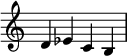
This appears first in his A minor violin concerto, op. 77, as well as his fifth and sixth string quartets, tenth symphony, and a variation or recognizable sort of similar thing in his first cello concerto, too. It also appears in every movement of this quartet.
As we discussed in the previous article on this program, Shostakovich’s seventh quartet was a dubious memorial to his first wife on what would have been her 50th birthday. Here, though, Shostakovich ponders his own mortality, catalogues his own sorrows, and it can read like a premeditated musical obituary the composer penned as he thought about his own life.
But you can also listen to it like a musical word search: what are the quotations, why are those works chosen, and what might they mean?
Music
The first movement begins with the DSCH motif in canon. It’s bleak and barren (remember: Dresden). It also quotes the composer’s own first symphony, his graduation piece when he was only 18 years old. In contrast with that youthful work, the mournful lines here, especially from first violin, seem enervated and resigned, perhaps hollow is the word. This first movement of a (connected attacca) five-movement work then begins to feel like a meditative, solemn introduction or prelude. Main players here: DSCH, quote from first symphony, and quotes from fifth symphony.
We swell suddenly to the biting, sharp, angular crunch of the second movement. Parloff describes it as a “thuggish, jackbooted scherzo.” It’s the shortest movement of the five and as frenetic and unnerving as the first was still and mournful. We get a chilling quote here, the klezmer-ish wailing theme from the second piano trio in what sounds like a macabre, demented dance. It seems to function as a bit of a trio, as viola picks up the opening figure after the klezmer passage, but the klezmer quickly returns and leads into the next section.
The third movement is, as I believe Parloff says, a “valse macabre,” a masochistic minuet or haunting waltz. It does indee have a very waltzy quality, but more importantly, the opening theme is based again on the DSCH motif. We get a quote mid-movement from the opening/central theme of the first cello concerto that is also a variation of the DSCH motif. The exposed, transparent sound of the quartet is enhanced by tremolo and pizzicato effects.
Things slow down for the fourth movement, which might seem to be another plaintive thing, but it begins with a menacing banging-on-door figure. This second of three largos is the longest movement of the quartet, and in contrast with the ghostly, diaphanous sound of the violin in the opening movement, the mourning is taken up here by the lower voices, giving a weightier, more grave tone.
We also get relevant quotes here, including a favorite war song of Lenin’s about the torments of imprisonment, as well as a quote from the infamous Lady Macbeth, Katerina’s “at last I see you” moment after being reunited with her lover. This melody, in the very high treble register of the cello, is the only thing in this entire quartet that smacks at all of some kind of comfort or reassurance, and it is fleeting. Perhaps some twisted idea of his own death reuniting him with Nina or other lost loved ones…
That doesn’t last, though, because our threatening knock returns to close the movement. Someone’s at the door and they’re not going away.
The fifth movement greets us again with the DSCH motif from the cello, rounding out an arch form to the overall piece and making plentiful use of the DSCH theme. The music dies away without giving any glimmer of hope. There’s no definitive resolution (at least not a hopeful one), no verdict, no emotional conclusion reached beyond being more assured of the emotional state with which the piece opened. It’s very convincing.
Coda
What strikes me in this quartet and many other works from Shostakovich especially is how deeply moving and beautiful something so tragic and heartbreaking can sound. I can only call it soulful for lack of a better word. It is so sincere, so honest, so deeply felt, that at least this listener os more overcome with its beauty than its tragedy, and both are part of the human experience, whether in political contexts or not. Sorrow is unfortunately somewhat universal.
We’ll be looking at something much lighter to close out this program, but for now, here’s the music. Thank you for reading and listening.
Score
All movements played without pause, so only one video here, but the timestamp will change for each track.
Links
Next: Beethoven String Quartet no. 7 in F, op. 59 no. 1