

Glass Violin Concerto no. 1
in which the composer blossoms beautifully into symphonic writing
performed by Gidon Kremer and the Vienna Philharmonic under Christoph von Dohnányi
I wrote the piece in 1987 thinking, let me write a piece that my father would have liked [...] A very smart nice man who had no education in music whatsoever, but the kind of person who fills up concert halls. [...] It's popular, it's supposed to be — it's for my Dad.
The search for the unique can lead to strange places. Taboos - the things we're not supposed to do - are often the most interesting. In my case, musical materials are found among ordinary things, such as sequences and cadences. All that I threw out in 1965 I've gradually brought in again, making it my own.
Let me get my brag out of the way early: I have something of a claim to a personal connection to one of the people involved in the creation of this work and will never stop bragging about it.
You know the ‘six degrees of separation’ idea? That through six connections (“I know someone who knows someone who knows someone who…”), everyone is connected to everyone else on earth. Statistically it’s more or less factual, I guess, but it’s a lot cooler when you can see in practice one of those places where your own network breaks through to people who you know allow you to ‘connect to’ (not even in any casual Facebook or even LinkedIn way, just a technical bragging rights way) to people who certainly know very important famous other people.
Long story short: I was on a mission years ago to try to find a capable, willing ensemble to perform, record, and reissue recordings of Milton Babbitt’s five extant string quartets (numbered 2-6; he withdrew his first), and this hunt led me to an ad hoc ensemble called the Zukofsky Quartet, named in honor of Paul Zukofsky, to whom I reached out. This endeavor later led to conversations with Randy Schoenberg and Babbitt’s own daughter, with whom I had a delightful conversation, but Zukofsky is the key player for the purposes of this article.
Dennis Russel Davies is an important name when it comes to any discussion of Philip Glass’s works, and to oversimplify and paraphrase as if I were someone who could pretend they were there when it happened, he more or less told Glass, “I’m not going to let you be one of those composers who only writes stuff for the theater and never writes any symphonic music.” Somehow Zukofsky was in on it and that was the thought/conversation/sentiment that precipitated the first violin concerto, and Zukofsky himself gave the world premiere.
It’s also worth mentioning that Zukofsky also played Einstein in the beloved Einstein on the Beach and in The Photographer, which I was fortunate enough to see here nearly a decade ago.
(He would tell me later in an email that he had more or less lost interest in the style of music represented by this work, not necessarily specifically Glass’s music, but that he hasn’t done much else with minimalism since then. Unfortunately, it seems he never recorded the piece. Incidentally, he also refused in no uncertain terms to speak at all about the works of Alfred Schnittke, which he made clear that he loathed. Zukofsky died of non-Hodgkin lymphoma on June 6, 2017.)
So that’s my personal connection to the work and how I am only a couple of degrees separated from Glass, Davies, and just one more degree from everyone they know.
Background
I’ve already said it, but Wikipedia’s first sentence in its entry for this piece states:
Philip Glass's Violin Concerto No. 1 was commissioned by the American Composers Orchestra for soloist Paul Zukofsky and premiered in New York City on 5 April 1987.
I was alive by then!
We’re not all that far removed at this time from the Philip Glass of Einstein on the Beach, Satyagraha, and Akhnaten, and it feels a bit like his earlier chamber/ensemble works like Music with Changing Parts, etc. The piece seems very much constructed around cells, especially rhythmic cells or figures, rather than melodic or thematic material like you’d find in a more traditional piece, but this works for Glass’s voice in a very Baroque way.
Also, in contrast with what I said in my recent article on Glass’s eighth symphony, this piece does feel like Glass doing Glass things with an orchestra, as he admits:
This piece explores what an orchestra can do for me. In it, I'm more interested in my own sound than in the capability of particular orchestra instruments. It is tailored to my musical needs.
Nothing wrong with that.
Music
What’s interesting, and immediately noticeable/approachable, about minimalist music like this or the preceding Short Ride is that in contrast with measuring or monitoring harmony or something like that, rhythm and meter are very easy to count straightaway. There are a lot of interesting things going on rhythmically, especially in the first movement.
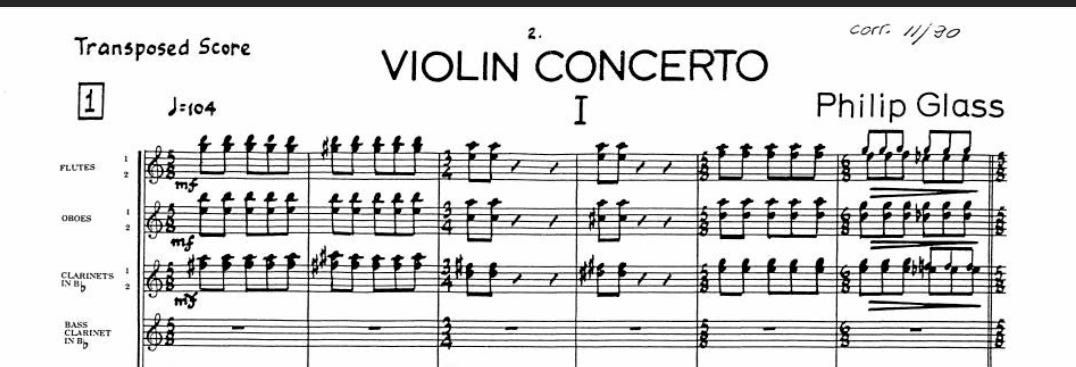
From the opening, we see fun things like two bars of 5/8 shifting to 3/4 and then to 6/8. There’s a mathematical interest to this in that 3/4 and 6/8 are of equal length, but one is a double meter (2*3) and one is triple (3*2), and the triple meter is only one beat longer than the 5/8 opening. What it feels like then is shifting gears, swapping a larger or smaller one out on the fly. There’s continuous motion, but small little shifts in meter can make big changes in how the music feels.
The words ‘churning’ and ‘chugging’ come to mind, like more and more whirring, spinning gears are constantly being added to and then removed from this machine. These rhythmic cells grow and morph and there are lots of repeated four-bar passages that make for standard eight-bar phrases.
One thing to listen for is what feels like 12/8 ( four triplet beats), but is actually notated thusly:

16th notes laid out in 3/4. Brahms does this sort of thing where he’ll play around with 3/4 or 2/4 and go over bar lines to give this soft, seamless, unending lyrical line of music. Glass is much more angular about it, but think of a giant, mechanical flower that complicates, blossoms, and unfolds with the violin soloist at the forefront of this growth. It’s virtuosic and exciting and deeply interesting.
The second movement is as interesting as you are contemplative. It is, to be blunt but not negative, somewhat uneventful. It’s uneventful in the same way that watching a beautiful landscape is. You’ve hiked up a mountain or hill to a good lookout point and can see trees, the horizon, the contours of the mountains in the distance and the way colors change and fade in the distance. That’s beautiful, but it is largely static. Some people could sit and stare at that for hours, and often do, and find it cathartic and relaxing and restorative. Wonderful. But that’s a function of how they perceive and enjoy it, not of anything exciting or interesting that happens there. It’s meditative.
It, too, is very baroque, with a ground base (like a passacaglia) that forms the spine of the entire movement. The violinist has two main ideas here: largely static, long-held high notes that soar over the landscape of the ground bass, and shorter, punctuated chords. These few ideas get passed around the orchestra, so instead of the constantly undulating, lively rhythmic shifts of the previous movement, the subsections of the orchestra pass material around, trading roles with each other.
The solo violin here I find to be so simple, naked, even barren at times, and it makes for a very solemn, melancholy atmosphere that we’ll revisit in the finale.
The third and final movement was specifically requested by Zukofsky to be a slow one, but we can see pretty quickly that that’s not what’s happening, at least at first. We’re back in 3/4 and bassoon gives us a pulse that contracts from three beats down to two, down to one and a half.
Triangle and woodblock give this movement a lively Latin-dance flair, calling to mind (in a minimalist setting after all) the castanets that inspired Reich’s Clapping Music.
We get many more repeated phrases here like in the first movement, except the repeated cells here are eight bars, giving a 16-bar section. These eight-bar repeated sections are broken up into two parts by what the solo violin acrobatically presents:

The movement seems rondo-esque, with the violin often presenting one of three ideas: the 16th notes above, more punctuating chords, or a syncopated rhythm, and this one gets prominently picked up by the orchestra at various points.
Glass is doing a lot of lifting here: he wrote it with his father in mind. He’s fulfilling a commission from Davies and Zukofsky, writing a work that is clearly in his own voice and feels like ‘what [he] wants to write,’ and needs to check the box of the slow finale that Zukofsky requested. He doesn’t get an entire slow movement, but things calm way down in the coda, at rehearsal mark 33, marked Poco meno (quarter note = 104).
We said we’d be hearing more of the second movement’s material, and here it is: a callback. All boxes ticked, everyone satisfied, even, hopefully, you listeners.
Coda
This is not a piece I revisit often. It’s not one I feel moved to listen to much at all, but it is charming, interesting, fun, satisfying. Is it magical? Maybe. It certainly possesses a hypnotic, mesmerizing, clock-like nature that can spellbind, but I’m not so sure it’s magical in the sense that it has profound secrets to reveal over years of repeated, focused listening. It does what it says on the tin: it’s a very satisfying, rewarding listen, and a very good gateway drug into Glass’s symphonic music (I suppose for both listener and composer alike).
Links
Next: Magnus Lindberg’s Chorale